The Concussion Recovery Blueprint®
The Physician's playbook for concussions
I'M READYAll The Tools You Need To Build A Successful Online Business
Lorem ipsum dolor sit amet, metus at rhoncus dapibus, habitasse vitae cubilia odio sed. Mauris pellentesque eget lorem malesuada wisi nec, nullam mus. Mauris vel mauris. Orci fusce ipsum faucibus scelerisque.
- Sports-related concussions in US annually 1.6 to 3.8 million
- Many more concussion go unreported
- 5% to 10% of athletes experience a concussion during a single season.
- High School Concussions
- Boys' football — highest overall rate at 10.40 per 10,000 athlete exposures
- Girls' soccer — 8.19 per 10,000 athlete exposures
- Boys' ice hockey — 7.69 per 10,000 athlete exposures
- Boys' wrestling = 5.8% of all reported concussions
- Girls' basketball = 5% of all concussions
-
NCAA 2014–2019 recorded 3,497 concussions across all sports
- Mixed martial arts — 147 concussions per 1,000 athlete exposures, 1 in 7 fights results in a concussion
- Australian Rules Football — 9.53 concussions per 1,000 athlete exposures, the highest-risk team sport
- Rugby union — 4.73 per 1,000 athlete exposures in match play, rising to 9.05 per 1,000 in elite English Premiership Rugby
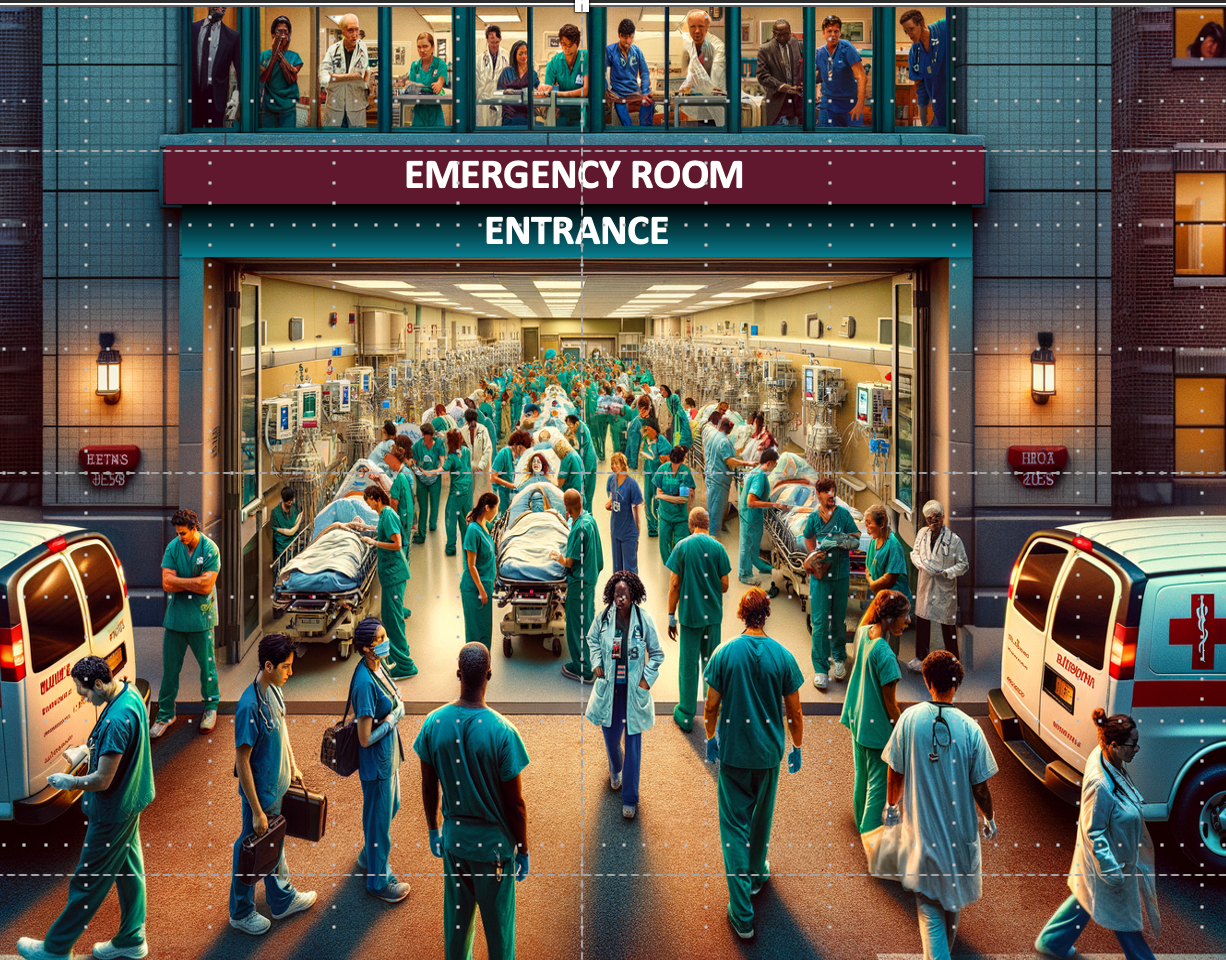
What They Did Not Tell Them At ER
They got checked out. They got a CT scan, a nod, and a discharge sheet. They were told "you're fine."
You were not told the truth.
The truth is, a concussion doesn't always announce itself in the ER. Sometimes it waits.
- Symptoms can stay silent for up to 72 hours — you could walk out of the ER feeling "cleared," and wake up two days later with a brain that's still injured.
- This isn't a two-week problem. For some, it's a one-year-or-longer problem — headaches, fog, and dysfunction that outlast every excuse anyone gave you to "just push through."
- A full year later, measurable brain dysfunction can still be present — not felt, not imagined, measured.
- Nearly 1 in 4 women monitored after injury showed two or more abnormal menstrual patterns within 120 days — a consequence almost no one warns female patients about.
- Sexual dysfunction can persist a full year post-injury, with adults ages 24–49 showing a threefold increase in impairment.
The ER's job was to rule out a bleed. It was never designed to catch what happens next. That's the gap where recovery quietly falls apart — unless someone actually manages it.
There's No Concussion Fairy

The 2 Minute Warning!
Hope is not a treatment plan. "Rest and wait" is not a treatment plan. "Maybe it'll just go away" is a gamble with someone's brain — and the data shows how often that gamble is lost.
Untreated and mismanaged concussions don't just fade quietly into the background. They compound. They resurface years later as depression, isolation, addiction, and — in the most devastating cases — as suicide.
Consider what inadequate care actually costs:
- Nearly half of homeless men report a history of traumatic brain injury — a staggering link between an "invisible" injury and one of society's most visible crises.
- Teens who've had a concussion show significantly elevated rates of suicide attempts compared to their uninjured peers.
- Head-injured children are more likely to withdraw socially — becoming isolated at exactly the age when connection matters most.
- Teen concussions are linked to a measurably higher risk of depression, often surfacing long after the "cleared to play" note is signed.
- A troubling share of people with mild TBI report suicidal ideation, and some go on to attempt suicide.
This isn't a scare tactic. It's a call to action. A concussion left unexamined isn't a problem that resolves itself — it's a problem that waits.
The Untapped Opportunity: Why Concussion Care Is the Practice-Growth Play Most Clinics Are Missing
There's a gap in modern healthcare that most physicians walk past every single day — and it's worth billions.
Concussion patients are everywhere. They're in your waiting room already, misdiagnosed as "stressed" or "tired." They're sitting at home with a discharge sheet that told them to rest and hope. They're athletes cleared to play by someone who checked a box, not a brain. And almost none of them are being managed by a clinician who actually understands mTBI recovery.
That gap is your opportunity.
The Numbers Tell the Story
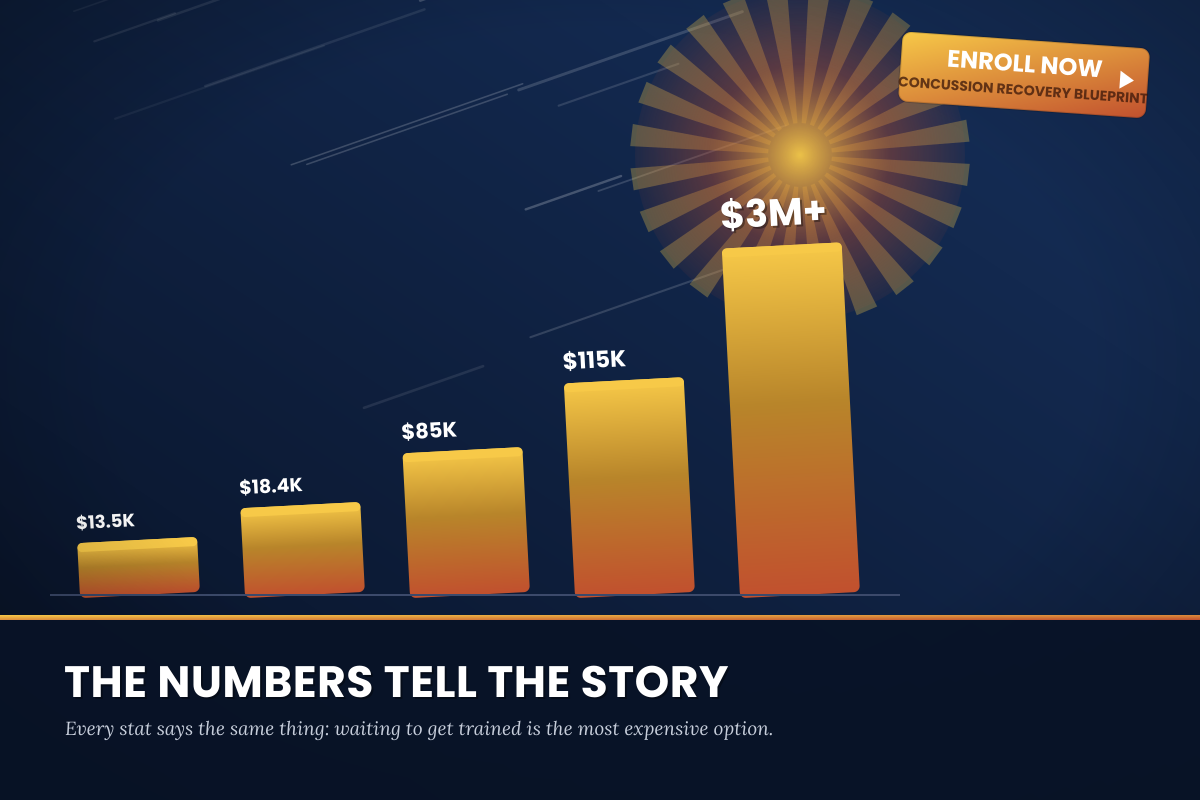
The outpatient market alone is enormous. Physician office visits for mTBI patients — the ones who never got admitted, never got specialist follow-up, just got sent home — numbered 80,041 patients, carrying a mean treatment cost of $13,564 per patient. That's not a niche. That's a market.
Sports medicine is a pipeline of its own. High school football alone drives concussion treatment costs as high as $115,000 per case when care is fragmented, delayed, or mismanaged. Every athletic program in your community is a referral funnel waiting for a clinician who can own that care pathway.
The insurance industry has already put a number on it. Guardian Life Insurance Company of America pegged the average concussion treatment cost at $18,454 per case in 2020 — a figure insurers use to underwrite risk, and one that signals exactly how much room exists between what's currently spent and what's currently achieved in outcomes.
Acute hospital-based care is the expensive, inefficient default. At roughly $8,000 per day, hospital-based acute care is a cost payers are actively trying to steer patients away from — toward outpatient specialists equipped to manage recovery without a bed.
And the long game is staggering. Lifetime cost of care for an mTBI patient averages $85,000 — and in complex, poorly managed cases, can exceed $3,000,000 per person. That range isn't just a statistic. It's the difference between a patient who got expert care early and one who didn't.
What This Means For Your Practice
Every one of these numbers represents the same underlying truth: concussion care done poorly is expensive, prolonged, and profitable for no one — least of all the patient. Concussion care done well, by a clinician who's invested in becoming genuinely proficient, is a different equation entirely.
- A defensible clinical niche. Few providers in any given market can credibly claim concussion-management expertise. That scarcity is a competitive moat.
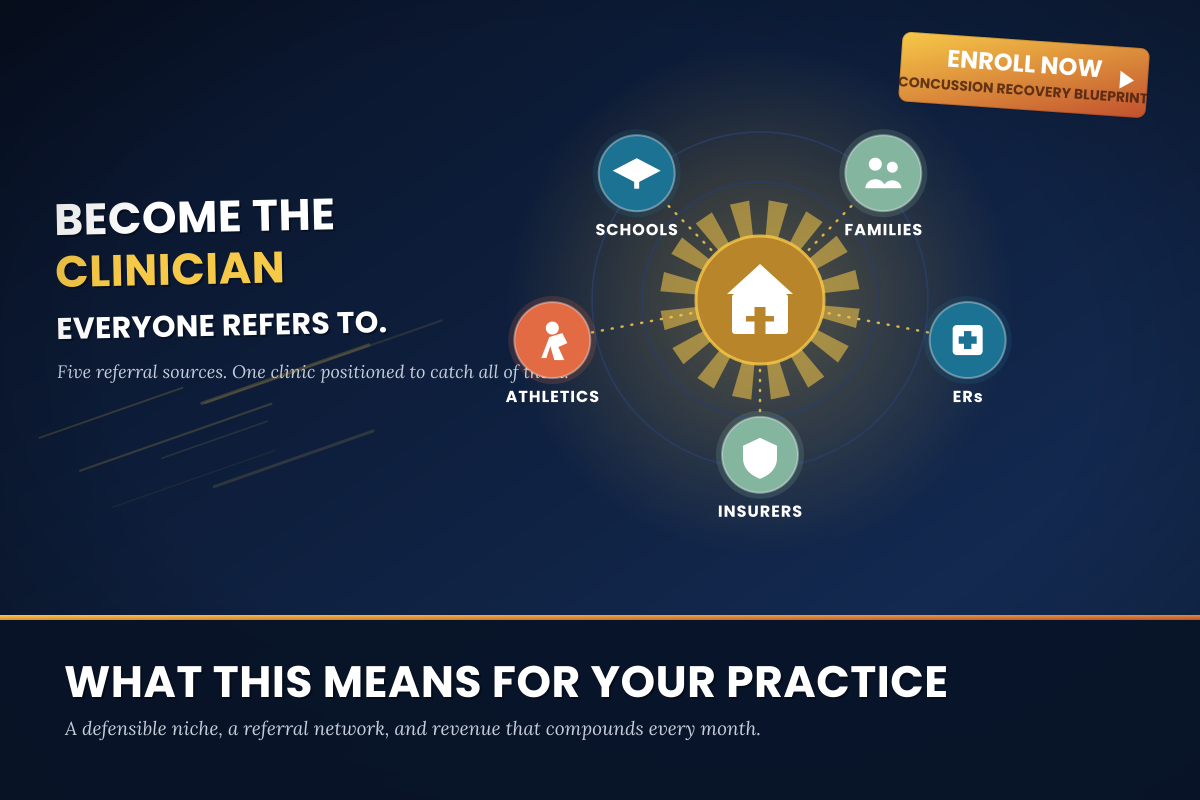
- A built-in referral network. Schools, athletic programs, ERs, primary care offices, and insurers are all actively looking for somewhere to send these patients — because right now, most of them don't have a good answer.
- Recurring, longitudinal care. mTBI recovery isn't a single visit. It's a multi-month relationship — office visits, monitoring, therapies, follow-up — that builds sustainable practice revenue while genuinely serving the patient.
- A hedge against the alternative. The $3M outlier isn't rare because mTBI is rare — it's rare because most of those cases were failed by fragmented care. The clinic that prevents that outcome isn't just doing good medicine. It's solving an expensive problem insurers, employers, and families are all desperate to avoid.

The Bottom Line
The market has already told you what mismanaged concussion care costs. What it hasn't yet decided is who gets paid to manage it well. The clinics and clinicians who build that competency now — real diagnostic skill, real treatment protocols, real follow-through — aren't just improving patient outcomes.
They're positioning themselves at the center of a healthcare gap worth billions, before the rest of the market catches up.
NICE TO MEET YOU
I'm Dr. Evan Mladenoff
I teach doctors and their staff how to evaluate the concussed patients’ brain + body so they can alleviate and reduce the symptoms they are suffering with and return to leading a full productive life!